

Business Rules Management System (BRMS) Market to Reach US$4.5 Billion by 2033 Driven by AI-Based Decision Automation
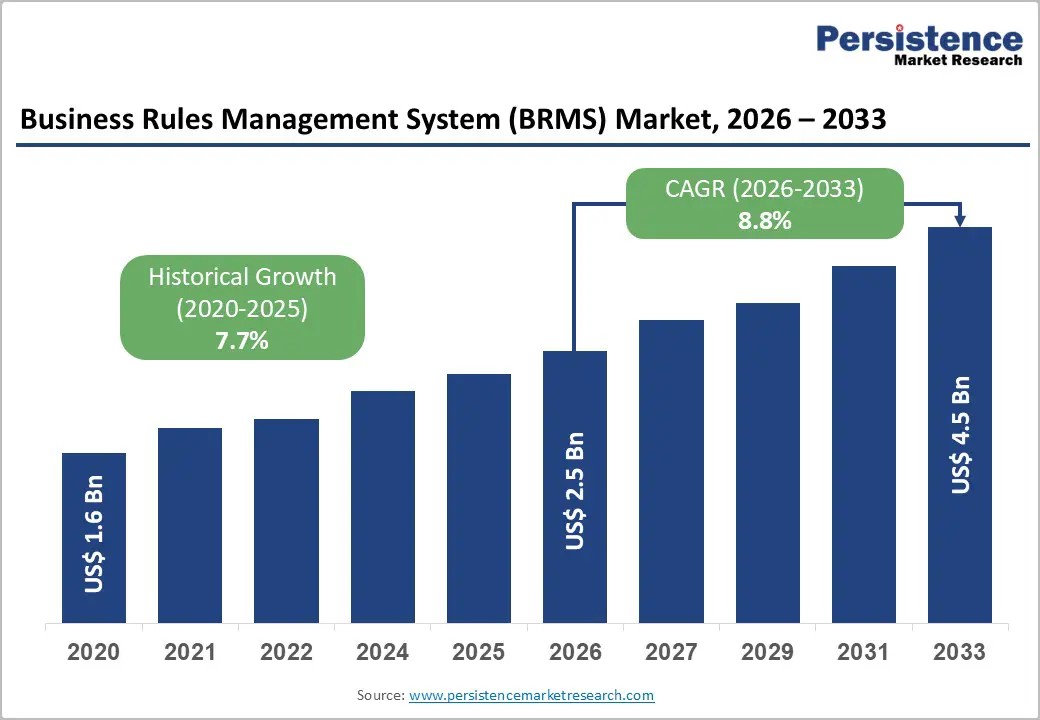
The business rules management system market to grow from US$2.5 Bn in 2026 to US$4.5 Bn by 2033, at an 8.8% CAGR, driven by agile decision automation adoption
BRENTFORD, ENGLAND, UNITED KINGDOM, March 5, 2026 /EINPresswire.com/ -- The Business Rules Management System (BRMS) market is experiencing steady expansion as organizations increasingly prioritize automated decision-making, regulatory compliance, and operational efficiency. The global BRMS market is expected to reach US$ 2.5 billion in 2026 and is projected to grow to US$ 4.5 billion by 2033, registering a CAGR of 8.8% during 2026–2033. Enterprises across banking, insurance, healthcare, and retail sectors are deploying BRMS platforms to manage complex decision logic, automate policy enforcement, and ensure consistent governance across digital operations.
One of the major factors supporting market growth is the rapid adoption of AI-driven decision engines, cloud-based governance platforms, and low-code rule authoring tools. The software component dominates the market with nearly 72% revenue share, as organizations prefer integrated rule authoring, monitoring, and compliance capabilities. From a regional perspective, North America leads the global market with around 38% share, driven by early technology adoption, stringent regulatory frameworks, and high enterprise IT spending. Meanwhile, Asia Pacific is emerging as the fastest-growing region, fueled by digital banking initiatives, fintech innovation, and large-scale cloud infrastructure investments.
𝐆𝐞𝐭 𝐚 𝐒𝐚𝐦𝐩𝐥𝐞 𝐏𝐃𝐅 𝐁𝐫𝐨𝐜𝐡𝐮𝐫𝐞 𝐨𝐟 𝐭𝐡𝐞 𝐑𝐞𝐩𝐨𝐫𝐭: https://www.persistencemarketresearch.com/samples/26761
Business Rules Management System (BRMS) Market Segmentation
The Business Rules Management System market is segmented primarily based on component, application, deployment mode, and end-use industry. Among these, the software segment dominates, accounting for a majority share of the market revenue. Software-based BRMS platforms provide organizations with centralized rule repositories, rule authoring tools, execution engines, and compliance monitoring systems. These capabilities enable enterprises to manage and update decision logic efficiently without altering core applications. As businesses increasingly adopt digital transformation strategies, the demand for integrated rule management platforms continues to rise.
In terms of application, the market includes rules monitoring and reporting, decision automation, compliance management, and natural language rule authoring. Monitoring and reporting currently hold the leading share because enterprises need real-time visibility into rule performance, audit trails, and policy compliance. Meanwhile, natural language rule authoring tools are witnessing the fastest growth, allowing business users to configure decision rules without deep programming expertise. The growing adoption of AI-enabled low-code platforms is further driving demand for user-friendly rule configuration solutions.
Regional Insights
North America remains the largest regional market for Business Rules Management Systems, accounting for nearly 38% of global revenue in 2026. The United States dominates regional demand due to strict regulatory requirements across financial services, healthcare, and insurance industries. Organizations rely on BRMS solutions to automate compliance workflows, standardize operational policies, and ensure transparency in decision-making processes.
Asia Pacific is projected to be the fastest-growing region, expanding at a CAGR of around 9.5% through 2033. Countries such as India, China, and Singapore are witnessing rapid adoption of cloud computing, AI, and fintech innovations. Government-led digitalization programs, coupled with growing enterprise automation investments, are accelerating the adoption of rule-based decision governance systems in the region.
Market Drivers
The primary driver of the Business Rules Management System (BRMS) market is the increasing demand for automated decision-making and regulatory compliance. Organizations operating in highly regulated sectors such as banking and healthcare must constantly update policies and operational rules to meet evolving regulatory requirements. BRMS platforms enable enterprises to centralize rule management and ensure consistent enforcement across multiple systems.
Another key driver is the rapid adoption of AI-powered decision engines and low-code development platforms. By integrating BRMS with machine learning and analytics tools, organizations can enhance operational agility and accelerate policy updates. This capability allows businesses to implement rule changes quickly, reduce manual intervention, and improve overall governance efficiency.
𝐃𝐨 𝐘𝐨𝐮 𝐇𝐚𝐯𝐞 𝐀𝐧𝐲 𝐐𝐮𝐞𝐫𝐲 𝐎𝐫 𝐒𝐩𝐞𝐜𝐢𝐟𝐢𝐜 𝐑𝐞𝐪𝐮𝐢𝐫𝐞𝐦𝐞𝐧𝐭? 𝐑𝐞𝐪𝐮𝐞𝐬𝐭 𝐂𝐮𝐬𝐭𝐨𝐦𝐢𝐳𝐚𝐭𝐢𝐨𝐧 𝐨𝐟 𝐑𝐞𝐩𝐨𝐫𝐭: https://www.persistencemarketresearch.com/request-customization/26761
Market Restraints
Despite its advantages, the BRMS market faces certain challenges, particularly related to high implementation and integration costs. Large-scale deployments often require significant investments ranging from US$250,000 to US$1 million, especially in organizations with complex legacy systems. Integration with enterprise resource planning (ERP), customer relationship management (CRM), and core banking systems can further increase deployment complexity.
Another restraint is the shortage of skilled professionals with expertise in rule modeling and decision governance. Effective implementation of BRMS platforms requires specialized knowledge in rule design, lifecycle management, and compliance monitoring. Limited availability of such expertise in emerging markets can slow adoption rates and hinder the full utilization of BRMS capabilities.
Market Opportunities
The expansion of cloud computing and AI infrastructure is creating significant opportunities for the BRMS market. Cloud-native BRMS platforms offer scalability, faster deployment, and lower operational costs compared to traditional on-premise solutions. These advantages make cloud-based solutions particularly attractive for enterprises seeking flexible and cost-efficient decision management systems.
Additionally, the growing emphasis on digital transformation and enterprise automation presents new growth prospects for BRMS vendors. Organizations are increasingly integrating rule engines with analytics, robotic process automation (RPA), and artificial intelligence to create intelligent decision-making ecosystems. This trend is expected to accelerate the adoption of BRMS across industries such as retail, telecommunications, manufacturing, and public administration.
Reasons to Buy the Report
✔ Gain comprehensive insights into the global Business Rules Management System (BRMS) market size, growth, and forecast.
✔ Understand key market drivers, challenges, and emerging opportunities shaping industry expansion.
✔ Access detailed segmentation analysis across components, applications, and end-user industries.
✔ Identify regional growth trends and investment opportunities across major global markets.
✔ Evaluate the competitive landscape and strategic initiatives adopted by leading market players.
Company Insights
Key Players Operating in the Market
IBM Corporation
Oracle Corporation
Pegasystems Inc.
FICO (Fair Isaac Corporation)
Red Hat Inc.
Progress Software Corporation (Corticon)
InRule Technology Inc.
OpenRules Inc.
ACTICO GmbH
Drools (Red Hat Decision Manager)
𝐁𝐮𝐲 𝐍𝐨𝐰 𝐭𝐡𝐞 𝐃𝐞𝐭𝐚𝐢𝐥𝐞𝐝 𝐑𝐞𝐩𝐨𝐫𝐭: https://www.persistencemarketresearch.com/checkout/26761
Recent Developments
In December 2025, GeeTest introduced a no-code/low-code business rules engine (BRE) with drag-and-drop flowchart configuration and automated code generation to enable rapid deployment of rule-based decision systems.
In November 2025, Circle Asia partnered with Scienaptic AI to enhance credit card underwriting using an AI-powered BRE platform that supports automated rule computation, lender matchmaking, and scalable decision processing.
Related Reports:
Pooja Gawai
Persistence Market Research
+1 646-878-6329
email us here
Visit us on social media:
LinkedIn
Instagram
Facebook
YouTube
Legal Disclaimer:
EIN Presswire provides this news content "as is" without warranty of any kind. We do not accept any responsibility or liability for the accuracy, content, images, videos, licenses, completeness, legality, or reliability of the information contained in this article. If you have any complaints or copyright issues related to this article, kindly contact the author above.
